Democracy does not end at the ballot, it continues with citizen participation in shaping our cities – sharing ideas and debating about the more granular issues including the use of physical spaces, housing and land management, city governance , services, etc. In an effort to highlight underrepresented issues, spur discussion, and showcase the innovative ideas and vision of urban planners, students, and concerned citizens – CairofromBelow will be holding an international ideas competition called “Our Urban Futures.”
We are in the process of finalizing the details, but encourage you to start thinking about cross-cutting ideas and tools that promote participatory planning and strengthen democratic practices in the evolving urban fabric of Cairo. Themes may include public spaces, empowering/supporting communities, historic sites/tourism, innovations in Cairo’s transportation, public infrastructure and land use. There will be prizes for top submissions and a panel of experts to provide feedback, advice and support. We hope to provide everyone involved with opportunities to further develop their ideas, and collaborate and network with colleagues and activists.
Additionally, we are working with partners to build a participatory planning digital tool that will allow any interested Cairene to locate proposed solutions to urban challenges on an online map.
We look forward to seeing how the proposals take shape. Please feel free to use the comments function to brainstorm ideas now while we finalize the rules of “Our Urban Futures” competition. The project is in conjunction with the Earth Institute Center for Sustainable Urban Development, Megawra, Urbanics and several other organizations and blogs, but we are still actively recruiting additional sponsors and partners and ask that interested parties contact us through the website, FB or cairofrombelow@gmail.com
Stay tuned for updates!
Investment in new towns, impractically distant from urban centers, has been a proposed solution to the housing crisis in Egypt. Economists, however, explain that such developments evidence a lack of understanding of the urban process. The informal housing sector in Egypt grows as a direct result of government policies that fail to offer viable alternatives or provide responsible egalitarian distribution of land.
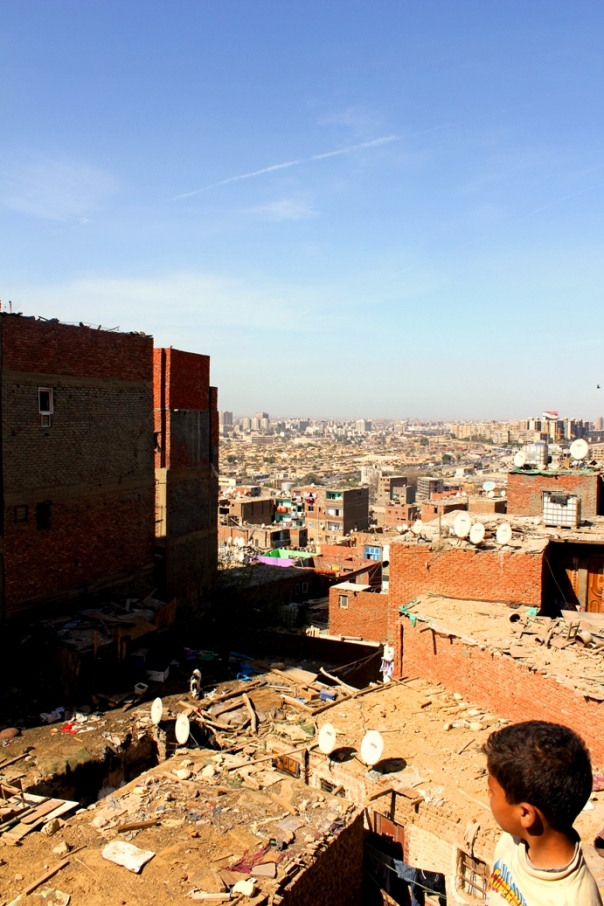
A young resident of Manshiyet Nasser looks over his neighborhood rooftops. Photo credit: Dana Kardoush
A recent article in Business Today by Amr Aref, discusses just this. Aref speaks with Khaled Abdelhalim, Executive Director of the Local Development Observatory Unit at the Ministry of Local Development.
Abdelhalim explains that the high percentage (60%) of Cairo’s informal area is due to the fact that the government does not offer reasonably priced land – and as noted in other posts sells it to investors below market price – making informality the only alternative.
The article also describes the government’s dual approach in which it jockeys between ignoring and recognizing informal areas, depending on the election cycle. The government did not begin to offer basic services until 1992. According to Abdelhalim, the government used the provision of services to their advantage as “political machinery”.
Abdelhalim criticizes the increasingly infamous Cairo 2050 visioning document, saying the revolution “erupted in the right time to scrap this nonsense.” Although Cairo 2050 has been abandoned, word of a similar document, an Egypt 2052, surfaced in July of last year. A Facebook page, Urbanism Revolution follows these developments closely.
Each informal area is characterized by a different type of informality and therefore faces diverse issues with equally complex solutions. For this reason Abdelhalim rightly supports participatory approaches, so that each solution is catered to each area.
There is interesting work being done to improve and develop informal areas across the globe. One project designed by Urban-Think Tank focuses on creating flexible public space in the Paraisopolis favela in Sao Paulo. The project is financially supported by the city and solicits feedback from residents, two elements that have not been seen simultaneously in projects in Cairo.
As Cairenes struggle on persistently towards their vision of the city they want, as parliamentary figures and presidential candidates discuss their priorities and agendas, and as the laws and policies are drafted, it is imperative that the urban planning debate is at the heart of discussions on the future of Cairo, just like it us at the heart of how people live out their everyday.
Look out for an announcement in the near future of an Our Urban Futures competition sponsored by Cairo from Below through which we seek to stimulate debate around how plans and decisions are being made in the city as well as to invite comment and new ideas about the planning and the process of planning as it exists.
Dana Kardoush is a member of a team analyzing governance over land in Cairo and a co-founder and contributor to Cairo from Below. Follow her @DanaKardoush.
A recent report issued by the Institute for Transportation and Development Policy and EMBARQ, titled “ The Life and Death of Urban Highways” is a solid look at the role and history of city highways across the globe. Citing planning trends originating in the 1960’s that prescribe highways as relief for urban congestion, the text criticizes freeways as barriers that “erode [the] vitality” of cities. It draws on many of Jane Jacob’s arguments articulated in The Death and Life of Great American Cities, and points to data proving highways do not alleviate congestion, and may in fact have the opposite effect.
The report laments the spread of these urban trends with many cities in Latin America, and more recently in

As part of Bogotá’s long-term mobility strategy, TransMilenio was implemented in place of constructing an elevated highway.
China and India building new highways and surface roads at a rapid pace. As a counter argument, it provides several case studies showcasing different cities that became stronger when freeways were removed or reconsidered. One particularly relevant case is that of Bogotá – as it runs parallel to the current situation in Cairo and the recent World Bank transportation proposal for th
e city mentioned in one of our earlier blog posts. Below is a short summary.
In the mid-1990’s Colombia’s capital, in an effort to decrease intense traffic congestion in the city center, considered two infrastructure and transportation plans. The first was from the Japanese International Cooperation Agency.
The second, written in response, was a mobility proposal from Bogotá’s mayor Enrique Peñalosa. The latter was selected and implemented. The following chart highlights elements of the two strategies.
| JICA Proposal | Mobility Strategy | |
| Proposer | Japanese International Cooperation Agency | Enrique Peñalosa’s administration |
| Main Components | Six highways, including two rings and four radial-ways. Inner ring w/ concrete bridge and toll. | TransMilenio Rapid Busy System, Greenways, bike paths, walkways, |
| Envisioned/Real Capacity | Inner ring envisioned to 35,000-45,000 passenger cars per hour in each direction by 2015 | TransMilenio currently carries nearly 1.7 million passengers per day. |
| Total Cost | $1.5 billion (in 2010 dollars) | $213 million – TransMilenio |
| Proposed Funding | JICA, tolls | Funded by a local surcharge on gasoline (46%), general city revenues (28%), World Bank Loan (6%), and grants from the National Government (20%) |
| Timeline | 10 years before Ring Road would be completed | |
| Other effects | Noise | Reduced traffic fatalities by 89%, increased bike use x5, Greenway transformed informal settlement area -encouraging local residents to be outdoors, 40% reduction in CO2, 32% decline in travel time, aggregated crime in area around transport has decreased, increase in property values |
Peñalosa’s plan not only revolutionized transportation, but also community, local markets, real estate, and many other elements of the city. It was a conscientious and innovative solution that served the direct needs of city residents.
The report concludes with three major alternatives to building new urban highways: 1) manage existing capacity more effectively, 2) invest in mass transit, and 3) implement land use policies that discourage sprawl and reduce unnecessary driving. At the moment, these tenets are not reflected in Cairo’s urban policies, although there has been some promising focus on the metro system.
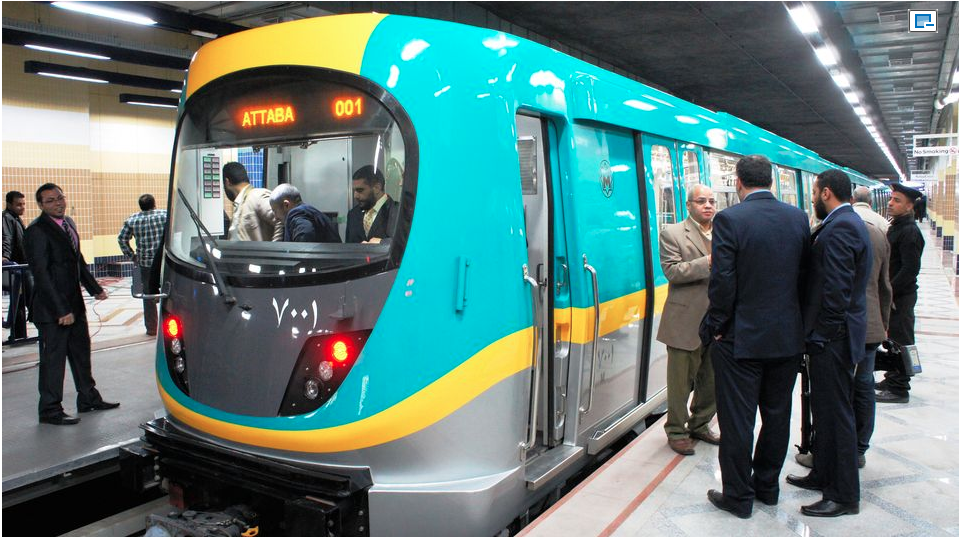
Japan-made train cars stop at Abbasiya Station in Cairo during opening ceremony on Feb. 21st 2012.
The city has the capacity, the talent, and the space to redesign its vision – it is waiting for leaders to provide and advocate for a plan of action.
TED prize goes to… The City 2.0

For the first time in the history of the prize, it is being awarded not to an individual, but to an idea. It is an idea upon which our planet’s future depends.
The 2012 TED Prize is awarded to….the City 2.0.
The City 2.0 is the city of the future… a future in which more than ten billion people on planet Earth must somehow live sustainably.
The City 2.0 is not a sterile utopian dream, but a real-world upgrade tapping into humanity’s collective wisdom.
The City 2.0 promotes innovation, education, culture, and economic opportunity.
The City 2.0 reduces the carbon footprint of its occupants, facilitates smaller families, and eases the environmental pressure on the world’s rural areas.
The City 2.0 is a place of beauty, wonder, excitement, inclusion, diversity, life.
The City 2.0 is the city that works.
Read the whole article at: Huffington Post.
Also check out http://www.thecity2.org/splash.php
An article in Business Today Egypt from January 19 on how the country’s real estate market has coped in the year since the revolution. As expected, the economic uncertainty felt in other sectors of the economy has affected the real estate market as well. This article provides a good overview of some of the issues facing the sector and some of the major developers in this time of economic and political uncertainty.
Housing and land scandals, if we remember, were big news in the weeks after Hosni Mubarak stepped down last February, and aggressive prosecution of them by the courts hindered the real estate sector as well. These were popular moves, since many of these companies were seen as connected to the corrupt political elite who ruled the country, and the homes they were building largely did not cater to the needs of the majority of Cairenes.
One thing to note is that these legal disputes seem to be closer to resolution, through compromise:
[T]he most likely scenario regarding land disputes is that they will be settled via a middle path where developers agree to pay additional considerations for their land rather than a worst-case scenario where land purchases are annulled. Also, we expect the focus of disputes to shift to project execution rather than the circumstances of land acquisition,” stated a report issued by real estate analysts at investment banking company HC Securities and Investment.
This raises an important consideration of the tension between economic growth and creating accountability. As we heard from the land scandals last year, a lot of land was sold to big, well-connected developers without proper public bidding, and for much-lower than market prices, potentially costing the Egyptian government significant revenues. Much of that land has been developed now, and this new mechanism of compromise means there will be no whole-scale revaluations or purchase annulments. As the article says:
At the end of November, that’s exactly what happened for Egypt’s biggest listed developer, Talaat Moustafa Group (TMG). An administrative court upheld TMG’s purchase of 8,000 feddans of land on the outskirts of Cairo, overruling an earlier lower court decision in June. TMG was accused of buying the land directly from the New Urban Communities Authority instead of bidding on it in a public auction. Since 75% of the land has been developed or is under development, only the last quarter will be subject to revaluation.
Should these land developers pay what the market prices were? In the current economic climate, is that a realistic thing to ask, as investors, especially foreign ones, might choose to put their money elsewhere?
Should they be allowed to keep the land in the interests of restarting economic activity? What becomes of accountability then, especially if the profits from these developments go to a limited number of developers? As you see from the photos, these luxury gated communities being built are not going to serve the majority of Cairenes and Egyptians, whose housing needs often stand in stark contrast to what these developers provide.
This issue is part of a larger debate occurring in Egyptian society, as the economy has taken a big hit following the uncertainty over the last year. Land is especially important, given the high profit margins it provides and the power that comes with that, along with its historic role in being a tool for the military, and former regime business elite in accumulating wealth, and being used as a tool of coercion by the old/current regime. There is some heartening news however, as these issues are starting to be debated in Parliament. MP Bassem Kamel of the Social Democratic Party chaired a committee hearing recently offering critiques of Cairo 2050.
Road to Khufu Video Goes Live!
Check out the Cairo from Below video on the proposed road to Khufu
What do you think about the proposed road and redevelopment zone? Please comment below.
Learn more at www.cairofrombelow.org
Please share your comments regarding the proposed Road to Khufu project (part of Cairo 2050) or comments to the video analyzing the proposed Khufu Road project.

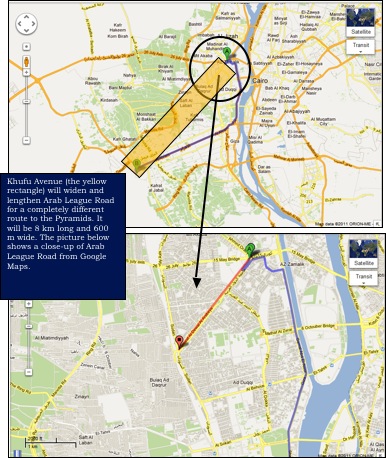
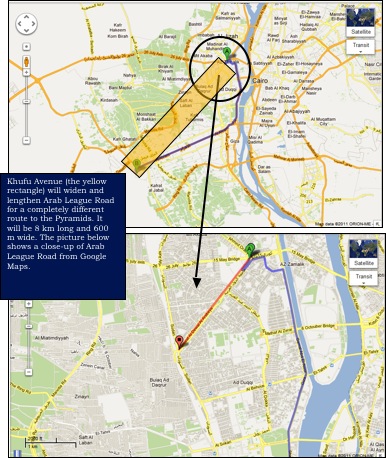
One element of the Cairo 2050 document is the creation of a wide boulevard from the Sphinx square to the area of the Giza Pyramids. The project proposes the extension of the Arab League Road by 6 km and a 540 m wide roadway and redevelopment zone which would include high-end hotels and offices in the space currently occupied by over 220,00 residents and small businesses. Khufu Avenue’s construction would require leveling of large areas of the of the Buulaq el Dukrur region – an area with one of the highest densities in Cairo – among other neighborhoods in its way, consequently causing significant displacement and segregation of informal areas from business and tourist areas.
There is currently no credible relocation plan for the residents who will be forced to leave. Many of the affected residents have lived in their homes for generations and depend on the social cohesion of their community for employment opportunities.
Moreover, this may not be the most effective investment in transportation in order to accomplish the stated goals. Three of the goals stated in the 2002 Greater Cairo Region Urban Transport Master Plan is that the cities transportation system be environmentally friendly, economical and Equitable system. Other mechanisms exist to move people effectively, often more effectively than building new roads. One such option is Bus Rapid Transit, (for more information see post https://cairofrombelow.org/2012/01/16/proposed-world-bank-loan-of-250-million-usd-for-egyptian-transportation/ or http://www.embarq.org/en/node/28) Bus Rapid Transit has been estimated to cost about 1/10 that of a subway system and much less than building a 540m wide road and real estate project. Importantly, these systems build upon existing infrastructure rather than requiring mass dislocation of thousands of residents.
Meredith Hutchison is part of a team analyzing governance over land in Cairo for Columbia University and the Institute for Research and Debate on Governance. She can be reached at cairofrombelow@gmail.com
Nicholas Hamilton is an architectural designer and international urban affairs consultant. He is also part of a team analyzing governance over land in Cairo for Columbia University and the Institute for Research and Debate on Governance. He can be reached at cairofrombelow@gmail.com
Sometimes building more roads isn't the best way to help people move around the city (photo credit Cairo from Below Team)
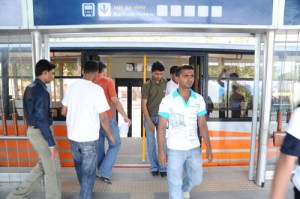
The BRT system in Ahmedabad, India is considered by many experts to be one of the best. Note: this BRT system shares many similarities to a subway metro system only it costs as little as 1/10 as much: passengers pay before entering; they enter through all of the buses doors; the platform is raised for easy and safe access; the buses have their own right of way that cars cannot drive on. (photo credit: ahmedabadbrts.com)

Bogota Columbia BRT - people move on the buses, cars can't get in the way (photo credit: ScottDalton_BogotaBRT_NYTimes)
With a high accident rate leaving 1,000 residents dead each year (more than half pedestrians) and poor public transport options, transportation in Cairo is in need of improvement. If nothing is done, average trip speed is expected to drop from 19km/hr to 12 km/hr a cost to the Egyptian economy estimated at over LE 7.5 billion/year by 2022. and increasing average commuting time to 1.5 hrs.
Yet, what is the best way improve transportation to get people and goods moving in Cairo? Would an Egyptian Pound spent on expressways be better spent on Bus Rapid Transit systems? Would new taxis or new buses improve air quality more than the other?
The 2002 Greater Cairo Region Urban Transport Master Plan, calls for 17 Billion US Dollars to be spent on transportation projects. While expressways were scheduled to received >45% of funds, only 18.6% of funds were scheduled for Subways or Bus Rapid Transit (BRT) systems. (Read more about BRT systems–buses with protected rights of way and prepaid boarding –here: Institute for Transportation and Development Policy or at the World Resources Institute EMBARQ site about BRT). If the stated goals of the GCR Urban Transport Master Plan include an environmentally friendly, economical and Equitable system of transportation for greater Cairo, then why spend the so much on expressways when the vast majority of the people live in the city of a density supportive of cost effective mass transit?
The World Bank has proposed a loan of $250 million USD for new fuel efficient buses and construction of six Bus Rapid Transit (BRT) Corridors. Is this enough? Is the World Bank planning to spend money on the right issues? Please share your thoughts on this topic in the comments area or write a response post, we would be happy to publish it.
Learn more about the proposed World Bank loan below:
Project Information sheet on World Bank website PDF (Arabic)
Project Information sheet on World Bank website PDF (English)
World Bank information portal on loan for Urban Transport Infrastructure Development:
Sources: Project Information sheet on World Bank website PDF (English)
Thank you to the Bank Information Center who alerted us to this project: Bank Information Center
قرض البنك الدولي المقترح البالغ 250 ألف دولار أمريكي لقطاع النقل في مصر
يحتاج قطاع النقل في مصر إلى تحسين، حيث يرتفع معدل حوادث السير مخلفا ألف قتيل من السكان سنويا (يمثل المشاة أكثر من نصفهم) كما تقل خيارات النقل العام. ومالم يتم عمل شىء، فإن متوسط سرعة الرحلة سينحدر من 19 كيلومترا في الساعة إلى 12 كيلومترا في الساعة، ويُقَدَر أن يُكلف ذلك الاقتصاد المصري أكثر من 7.5 مليار جنيه مصري سنويا بحلول عام 2022 إضافة إلى ازدياد متوسط وقت التنقل ساعة ونصف.
ولكن، ما هي أفضل وسيلة لتحسين قطاع النقل لتنشيط حركة نقل الأفراد والبضائع؟ هل أن ننفق جنيها مصريا على أنظمة عبور سريع للحافلات أفضل من أن ننفقه على الطرق السريعة؟ أيهما بإمكانه تحسين جودة الهواء أكثر من الآخر، الاستثمار في سيارات تاكسي جديدة أم في حافلات جديدة؟
إن الخطة الرئيسية لعام 2002 للنقل الحضري فى منطقة القاهرة الكبرى تنادي بالحاجة إلى إنفاق 17 مليار دولار أمريكي على مشاريع النقل والمواصلات. وبينما تَقرر حصول الطرق السريعة على ما يزيد عن %45 من هذه الأموال، لم يَتقرر لمترو الأنفاق أو أنظمة العبور السريع للحافلات سوى %18.6 من الأموال. (اقرأ المزيد عن نظم العبور السريع للحافلات-أحقية الحافلات بالجانب الأيمن من الطريق والركوب المدفوع مسبقا هنا: المعهد لسياسات النقل والتنمية (بالانجليزية) او على موقع امبارك التابع لمعهد الموارد العالمية عن أنظمة العبور السريع للحافلات(بالانجليزية)). إذا كانت الأهداف المعلنة للخطة الرئيسية للنقل الحضري في القاهرة الكبرى تشمل نظام اقتصادي متاح وصديق للبيئة فى القاهرة الكبرى، فلماذا إذا ينفق كثيرا على الطرق السريعة فى حين أن الغالبية العظمى من سكان المدينة المكتظة يرغبون في وسائل نقل جماعي فعالة وغير مكلفة.
يقترح البنك الدولي قرضا مقداره 250 مليون دولار أمريكي لتوفير حافلات جديدة تتسم بكفاءة الوقود وإنشاء ستة محاور عبور سريع للحافلات. تُرى هل يكفي ذلك لحل المشكلة؟ هل يخطط البنك الدولي لإنفاق المال على القضايا الصحيحة؟
من فضلك، شارك معنا بأفكارك حول هذا الموضوع على موقع “القاهرة من الأساس” للتعليق.

A growing number of online communities are hosting a rich online debate and sharing of information regarding urban governance and planning in Cairo. Some of our favorites are listed below. We are trying to assemble a list of individuals and groups writing about these issues, especially those on Facebook. Please post links in the comments section here to more platforms.
http://drawingparallels.blogspot.com/
http://www.facebook.com/pages/International-Alliance-of-Inhabitants/172586256110289

http://www.facebook.com/pages/Cities-Alliance/155449571161734
Update 15 January 2012:
http://shadowministryofhousing.blogspot.com/ (Thanks Ahmad!)
Update 11 February 2012:
Bank Information Center: Egypt
http://www.facebook.com/Carboun
Update 2 July 2012:
I recently had the opportunity to explore one of the Cairo2050 projects with members of the New Media Task Force at the School of International and Public Affairs at Columbia University. We will soon be launching a video outlining and detailing the impacts of this irresponsible construction project. Meanwhile, please read on to find out more , and as always please share your thoughts.
The project proposes the extension of the Arab League Road by 6 km and its widening by 540 meters of residential area. Khufu Avenue’s construction will require the rarefaction of the Buulaq el Dukrur region – an area with one of the highest densities in Cairo – among other neighborhoods in its way, consequently causing significant displacement and segregation of informal areas from business and tourist areas. There is currently no relocation plan for the residents who will be forced to leave.
Many of the affected residents have lived in their homes for generations and depend on the social cohesion of their community. The Khufu Avenue proposal is another example of the previous regime’s neglect of the people’s needs.
Dana Kardoush is part of a team analyzing governance over land in Cairo for Columbia University and the Institute for Research and Debate on Governance.


 Cairo from Below القاهرة من الأساس