

600,000 Egyptian Bedouins live in the peninsula on the country’s eastern border (Photo: Reuters)
A recent article in Egypt Independent states that under the new law on land ownership in the Sinai desert, the government will offer 100,000 acres, prioritizing Sinai Bedouins as purchasers. The law makes it so only Egyptians are permitted to buy the land and cannot resell or leave it to foreigners. This may begin to ease a fraction of the frustrations faced by Egypt’s Sinai Bedouins who, in addition to other dire conditions, previously had no formal rights to land ownership.
It is not clear if the law will eliminate the bureaucracy of acquiring property on desert land. According to research done by Cairo from Below team members, Hernando De Soto estimated it takes seventy-seven bureaucratic procedures in thirty-one different public and private offices for an Egyptian to formally get a plot of state owned desert land. Cairo from Below researchers explain that, according to their field research in March of 2011, all desert land in Egypt is considered state-owned unless sold by the state. State institutions thus own a large percentage of land in Egypt. The Ministry of Agriculture, the Ministry of Awqaf (religious endowments) and the Egyptian Military are among the largest owners of land in the country.
Intentional and mindful consideration of marginalized members of society can be essential to ensuring further progress, sustainable development, and greater equity. Hopefully this is the case in Egypt.
Dana Kardoush is the Cairo from Below Communications Coordinator. Kardoush is an alumnus of Columbia’s School of International and Public Affairs (SIPA). While at SIPA, along with fellow classmates and colleagues in Cairo, she contributed to forming Cairo from Below. Kardoush’s interest lies in civil society mobilization and community-led development in the Middle East, and as a Palestinian-American, she hopes to return to live and work in Palestine in the future.
Below is an Our Urban Futures Ideas Competition submission by Ahmed Adel. If you like the idea, don’t forget to like it or comment on it on the Cairo from Below Facebook page! Don’t forget to tell your friends about the idea to get them to like it so you can help the submissions you like best to win the competition!
Do you have another idea? A better idea? Submit your own idea on the Cairo from Below Facebook page and get your friends to like it there, as well!

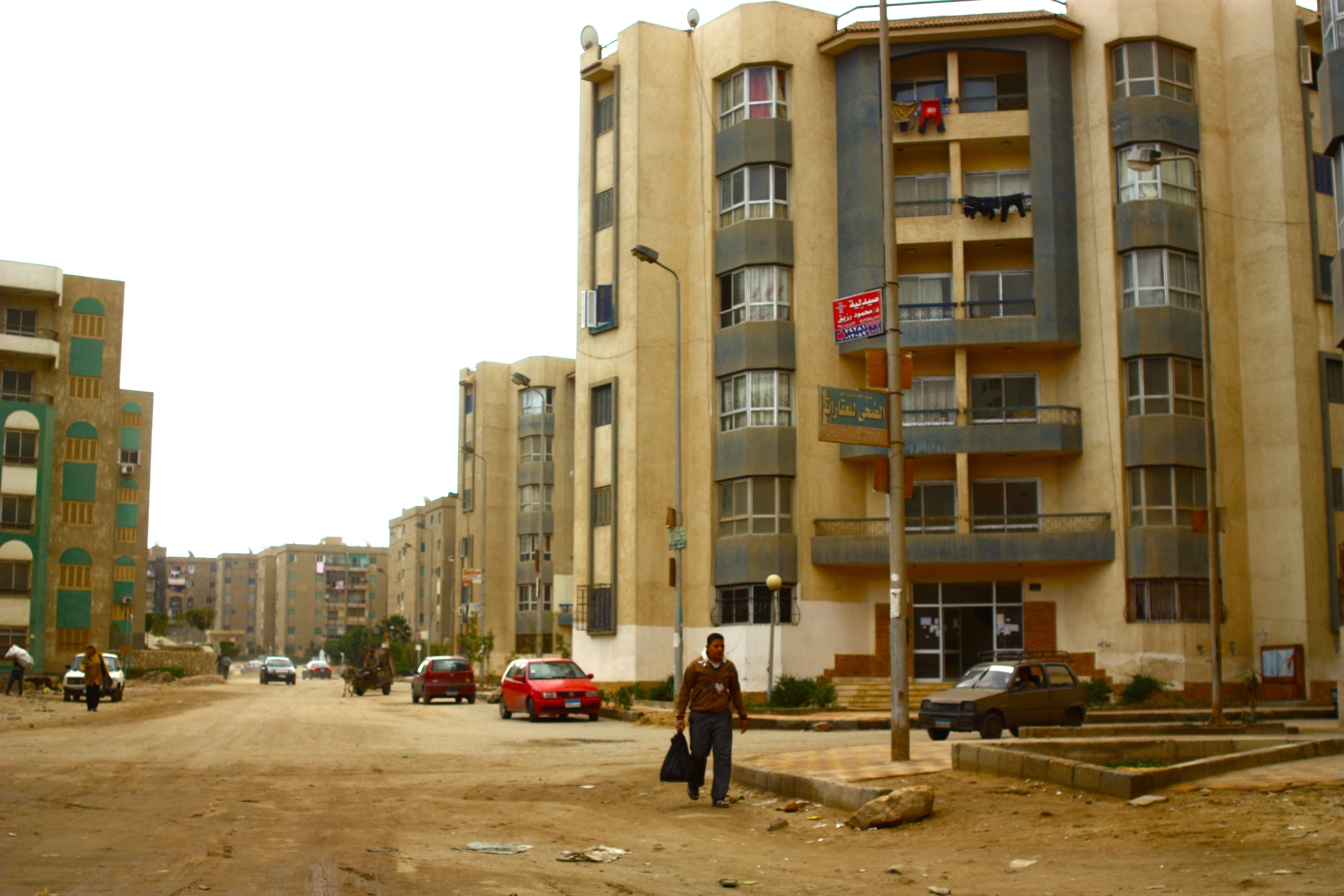
Public Housing in Cairo (Photo credit: Meredith Hutchison)
Cities throughout the world are increasingly tackling public health issues through policy approaches. However, all too often, the effects of policy and urban planning decisions on the health of some of the most vulnerable residents are overlooked. Health disparities are more common among homeless and unstably housed adults, families, and children due to economic insecurity and the link between housing status and health behaviors. Life expectancy among residents of slum settlements, such as those located in Cairo, is significantly lower than in other urban areas. Only by addressing economic inequities, including housing, can we begin to confront some of the most pressing public health challenges.
Low- and medium-income countries face the largest challenges to providing adequate living situations for all residents. Although homelessness in Egypt is often considered less significant than in other countries, most adequate housing in Egypt (i.e. dwellings with sufficient sanitation and ventilation, access to clean water, and without overcrowding) is out of reach for medium- or low-income families and individuals. In Cairo alone, millions of people reside in precarious housing in slums and squatter settlements (Levinson 2004, Encyclopedia of Homelessness), and millions more live in informal or poorly maintained structures. It is estimated that over 65% of the city’s population resides in informal settlements. Furthermore, there are an estimated one million children living in the street in Egypt, including 50,000 in Cairo. Conditions during the Egyptian revolution may have exacerbated poor housing conditions for some families, as they were evicted and forced into inadequate temporary camps, likely under the guise of unsafe conditions in their former housing.
So how does housing affect people’s health? Housing and health are fundamentally linked. Individuals who are homeless or unstably housed are more vulnerable to infectious diseases, physical violence, and injury. Furthermore, housing represents a fundamental cause, or social condition, that leads to health disparities. Adults and children living on the streets of Egypt, as well as other cities throughout the world, lack access to social and economic resources that promote health. Homeless individuals are more likely than those with adequate housing to engage in unhealthy and risky behaviors as a survival strategy, including alcohol and drug use and risky sexual behaviors (e.g. exchanging sex for money, drugs, or a place to stay). Research has confirmed the high prevalence of risk behaviors and other health risks among children living on the streets of Cairo. Many of these children are at high risk of contracting infectious diseases, especially HIV, and lack the resources to obtain adequate treatment.
Reducing housing problems in low- and middle-income countries like Egypt requires innovative and multifaceted approaches to a range of urban issues. Some NGOs, as well as individuals, are spearheading initiatives to reduce housing shortages in some of the most challenging economic and social conditions. Habitat for Humanity Egypt uses a collaborative construction and financing process similar to that practiced in the United States, but also provides no-cost homes to families who are unable to repay. In addition, Habitat for Humanity uses design innovations in response to local needs. Their vaulted/dome roof design is less costly than traditional construction because it does not rely on steel. It also allows for additions to the roof, a common housing solution among growing families.
Another organization, Ashoka, takes a grassroots approach to a range of social problems, including housing. By empowering social entrepreneurs, termed the “citizen sector,” Ashoka enables individuals to create positive social change throughout the world. For example, Ashoka Fellow Somsook Boonyabancha has addressed slum housing conditions in Thailand by negotiating agreements between squatters and land owners. Owners may develop the street-front portion of property, but in exchange, they must construct dense housing for squatters behind the property. Although this approach may not be appropriate for Cairo, development that incorporates both private interests and the needs of current residents may offer some solutions.
In addition to work being done on health and housing at Ashoka, Cities Alliance has brought together local authorities, national governments, NGOs, and multi-lateral organizations to encourage sustainable development with the goal of urban poverty reduction. By funding City Development Strategy and Slum Upgrading projects throughout the world, Cities Alliance provides resources that allow municipalities to develop and execute urban planning and development strategies that meet social objectives.
Ideas like these have the potential to alleviate some housing shortages in low- and middle-income countries. Although solutions to housing problems may seem distal from the public health issues they also combat, they are essential for creating more equitable and healthier communities. Housing initiatives must also target the most vulnerable individuals with existing health conditions, such as HIV, or those at high risk. This might be accomplished by providing designated developments or apartments.
Health service organizations working in Egypt and other low- and middle-income countries must begin to address fundamental, or upstream, causes of health disparities, and recognize and advocating for housing as a form of treatment and prevention. Specifically, transformations in Egypt’s and Cairo’s governmental and policy environment create an opportunity to address health through urban development decisions. Only by taking a holistic and multidisciplinary approach to developing cities can we begin to create healthier and more equitable communities.
Anne Bozack, MPH is a Project Director in the Center for Evaluation and Applied Research at the New York Academy of Medicine (NYAM). She is currently working on health disparities and prevention of chronic disease in urban populations. Prior to joining NYAM, Anne gained research experience at Columbia University focusing on homelessness, prisoner reentry, and HIV/AIDS and earned her MPH while there.
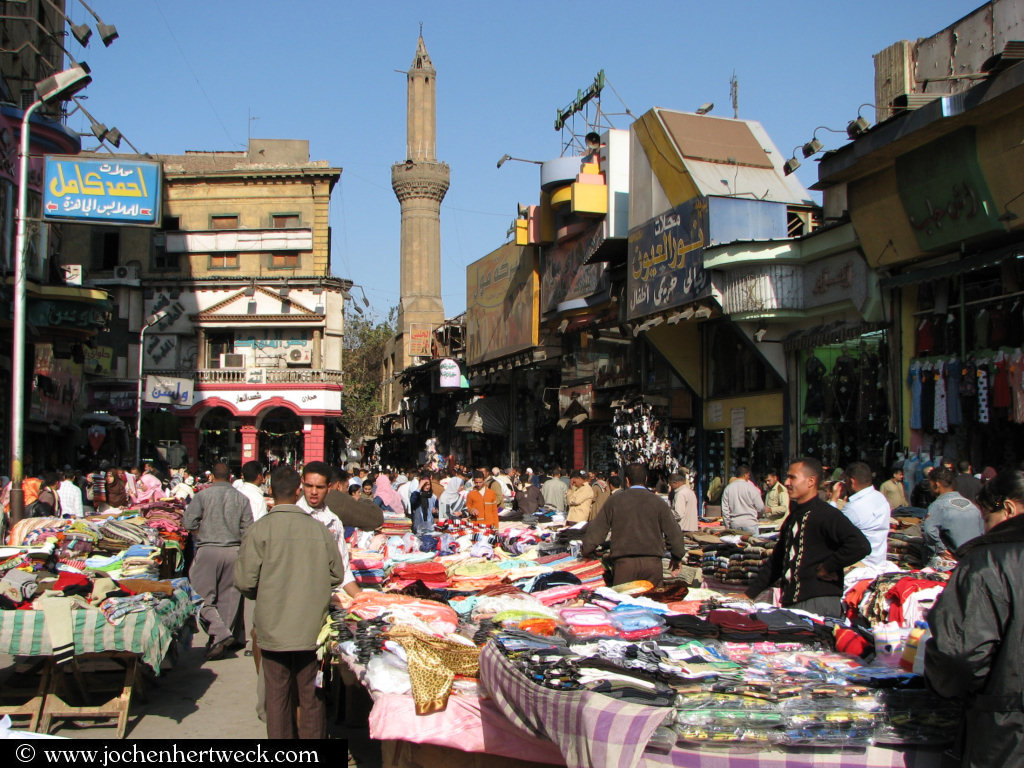
Vendors on a street in Cairo (photo credit: http://www.jochenhertweck.com)
Street vendors in Egypt make up a substantial part of the informal economy, a powerhouse that is responsible for 25% to 60% of GDP according to some estimates. When unemployment is high (over 12% at the end of 2011), and bureaucratic red tape and corruption make opening a bricks-and-mortar establishment an obstacle course of permits and bribes, selling on the street is often the only work within reach. According to Sherif Delawar of the Arab Academy for Science and Technology, the informal economy is what has kept the economy going during and since the revolution. Vendors have thrived, in part, due to diminished harassment from police, who have turned their focus elsewhere. While their success speaks for itself, the vendors are not universally welcomed. They are blamed for undercutting established shops, producing trash and noise and making Cairo’s famous traffic even worse.
Congestion is a significant and well-documented problem. According to the 2010 World Bank Cairo Traffic Congestion Study, congestion costs the city $13-14 billion LE ($2.1-2.3 billion USD) annually in wasted fuel and time. To allow traffic to flow more easily, the government is attempting relocation of street vendors to side streets or enclosed marketplaces, but this may not prove successful. Vendors will inevitably gravitate back toward the busiest and most profitable thoroughfares, where some would be willing to pay a fee for the right to do business.
Given the limited street space, the solution will involve more efficient use of it. Commerce is a legitimate and vital use of the street, as is transport. Vendors should be permitted to sell in well-trafficked areas that are visible and convenient to customers, as is being done in some areas. Buses should be given priority, perhaps by designating exclusive bus lanes, although they will depend on traffic enforcement unless there is a physical barrier. Limiting parking to designated areas is also important to maintain free-flowing conditions (again, enforcement is key).
The underground rail system should be expanded, given its already high ridership and Cairo’s density. Trams are perfect for Cairo’s narrow streets; a full light-rail system would complement the metro and attract long-term commercial investment from businesses that value mobility. As the transit system becomes built out, tolling and congestion charging may become viable. The World Bank recommends a Metropolitan Cairo Transportation Authority be formed to coordinate and oversee all aspects of transport. Having all functions under one roof would improve coordination and facilitate development of a comprehensive transport plan.
With the right strategy, transport and commerce can co-exist in the streets of Cairo. Both are essential to a thriving economy and a vigorous urban environment, which will benefit all Cairenes. Care must be taken not to undermine one success in the pursuit of another.
Matthias Hess is a Customer Service Specialist at New York City Transit where he focuses on online service communication. He is interested in all aspects of urban design, particularly transportation and architecture, and expects to pursue a degree in urban planning. Matthias studied Business Administration at Houghton College, focusing on international issues.
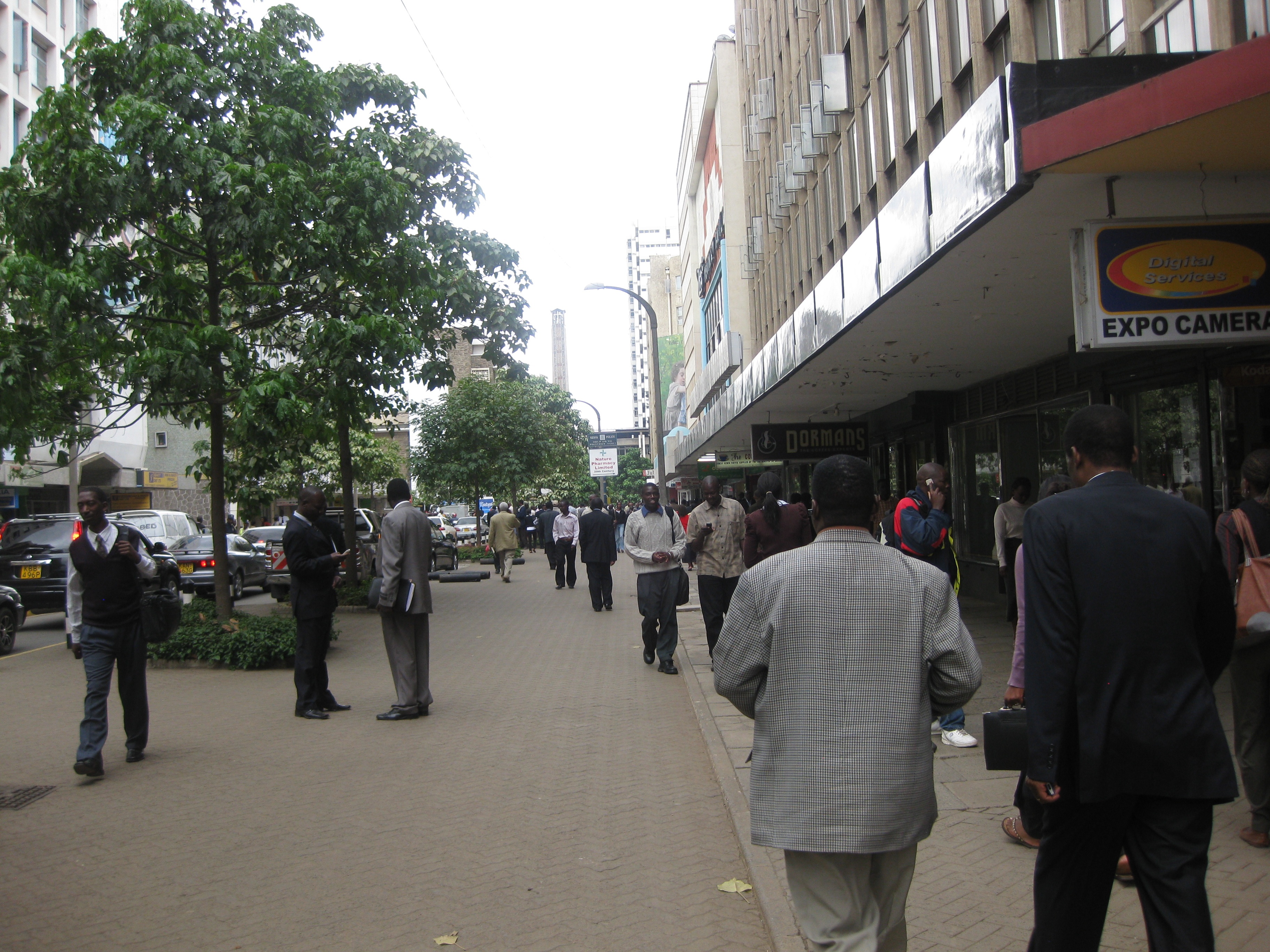
Mama Ngina Street
A recent article published by the Philadelphia, USA-based non-profit, Next American City, aptly foresees a future in which we are all urban planners. While the article, titled “When We’re All Urban Planners: Making a Virtual Village to Create a Better City” by David Lepeska, largely focuses on the relationships between – and advances in – technology, crowd-funding, and the funding and development of small neighborhood projects, the underlying implication of the article is one that is particularly relevant for initiatives such as Cairo from Below. That is, how can we create circumstances that empower citizens to contribute to the future of their cities?
Cairo from Below’s mission is to encourage inclusive, responsible, and transparent urban planning in Cairo. Inspired by the Cairo initiative, the Center for Sustainable Urban Development at Columbia University’s Earth Institute, in collaboration with its Kenyan partners, recently launched a blog aimed at encouraging open discussion about the future of urban planning and governance in the Nairobi, Kenya Metropolitan Area. Because access to key policy and planning documents is often difficult, limited, or non-existent in Kenya, the blog is meant to be used as a clearinghouse for documents and information related to the future of planning, policy, and governance in Nairobi. The founders of Nairobi Planning Innovations hope that, as has been done by Cairo from Below, the site will inspire people from Nairobi and around the world to contribute ideas on what a healthy, sustainable, and equitable Nairobi might look like. Although the blog was only recently launched, the founders have received a positive response from their partners in Nairobi and many have found the blog to be a useful resource for locating key policy documents.
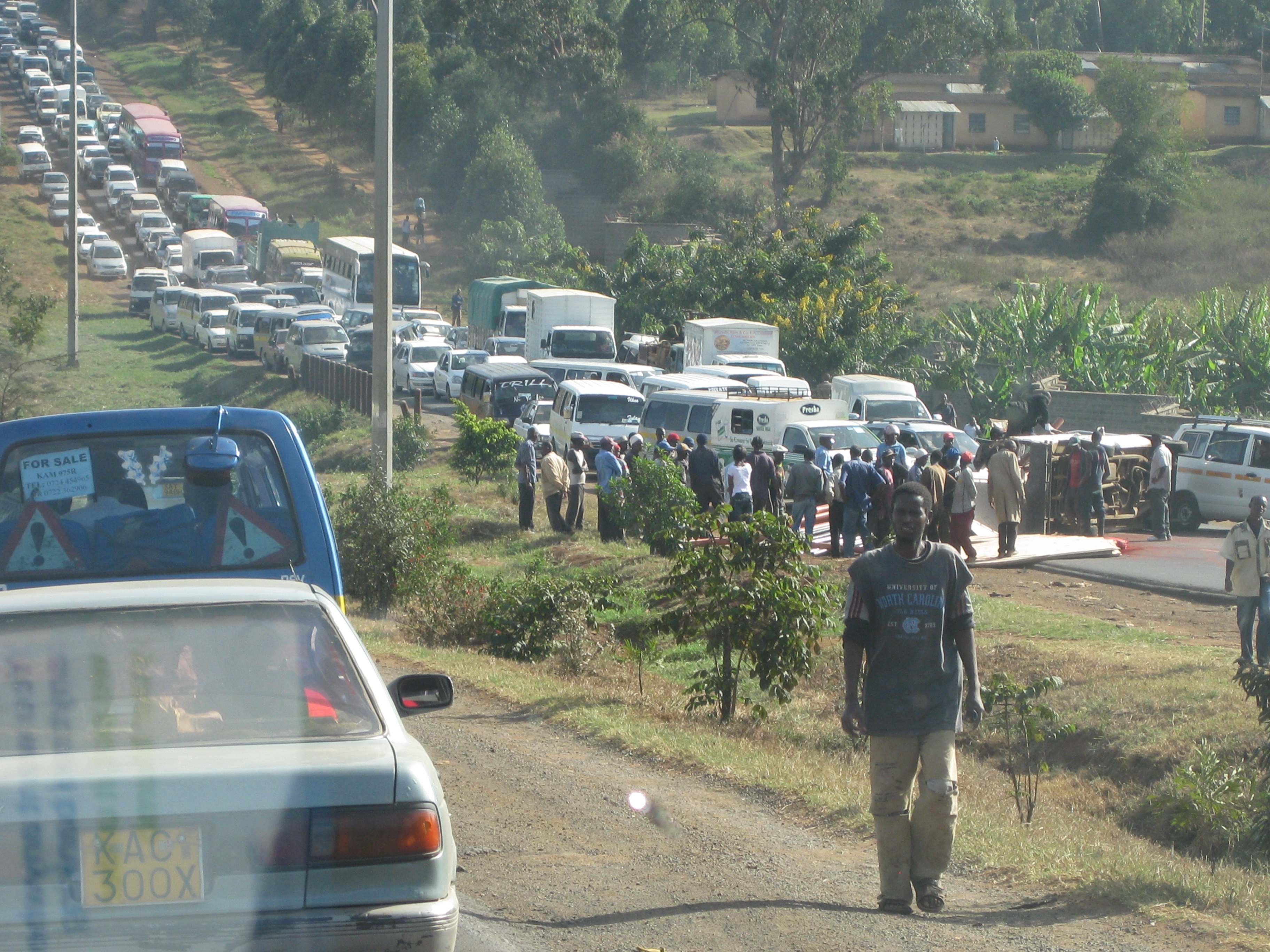
Thikka Road Accident
Not completely unlike the governance changes taking place in Egypt, Kenya is currently undergoing many changes in governance that have the potential to greatly impact the future of its urban growth. Kenya ratified a new constitution in 2010 that devolves government, increases the rights of citizens, and has the potential to democratize many state institutions. In this environment of increased political change, Kenya boasts a lively civil society and a free press. At the same time, much of the information that citizens need not only to be active and informed members of their communities, but information that they have a right to access such as plans and designs for a new superhighway through the center of Nairobi (of striking resemblance to the Road to Kufu in Cairo) or plans for new gated communities, are often not accessible to the public. Further, few fora exist where citizens can discuss, debate, and exchange ideas concerning urban planning, policy, and development.
Providing easy access to information about urban development and a space for people to discuss this information is one step forward in empowering citizens to contribute to the future of their cities. Or as Lepeska might say, to make all citizens urban planners. Citizens all over the world are using technology to share ideas, access information, and express opinions. Lepeska points out that the next challenge is a “conversational one.” That is, governments need to work with these burgeoning networks in order to build more sustainable and equitable urban futures. Increased citizen and non-government participation in changing cities can be seen as competition for municipal governments, but these things should be seen as ways to get citizens to work in synergy with municipal governments. Lepeska describes this as “closing the loop on public input,” or in other words, seeing citizens’ ideas come to fruition. Sites like Cairo from Below and Nairobi Planning Innovations are important tools in ensuring that people have access to information and are given an opportunity to express opinions about the future of their cities, but they don’t necessarily close the public input loop.
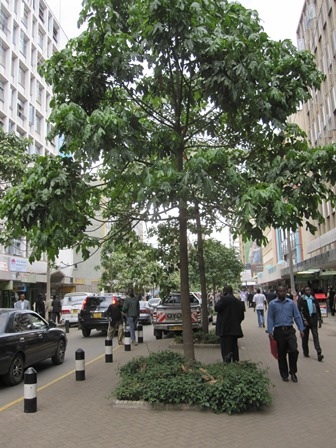
Mama Ngina
It is our job as residents who care about a brighter urban future to inspire our municipal governments and enroll them in conversations about our collective urban futures. There is great potential for initiatives like Cairo from Below and Nairobi Planning Innovations to inspire citizens engage their governments to plan for the future, especially in changing political environments such as those in Egypt and Kenya. Indeed, hopefully these two initiatives will just be one of many steps in the right direction towards closing the loop on public input.
Elizabeth Marcello, MIA is a project manager at the Earth Institute’s Center for Sustainable Urban Development (CSUD). She is currently cultivating strategic policy networks among public and private actors in Nairobi, and CSUD’s blog, Nairobi Planning Innovations, is only one part of their efforts.
 How can we increase participation and promote inclusivity of women in environmental projects? Well, what is really needed is data on the following topics in order to investigate the nature and severity impact of each over different timeframes in given locales. It will also be important to determine the cost and efficiency of possible response measures.
First, capacity development is necessary in order to devising gender response strategies. Emphasis on the participation of women in environmental decision-making, developing policies, plans and appropriate legislation in the field of supervision and control of development activities adversely affecting the environment and its vocabulary. Increasing advocacy and awareness by supporting women’s associations working in the field of education and environmental projects will financially and morally enable these fields to discharge their functions. We must also determine the proper ways to use the qualitative process of natural resources and ways of interaction with the environment and women by raising awareness of environmental laws.
Coordination, communication, and networking, with an emphasis on the role of media in spreading environmental awareness will highlight the role of women and stimulate their participation in climate change-related projects. This will allow us to direct messages to the appropriate information on climate change and how it impacts women, specifically, as well as how we might be better able to deal with it.
Clear information about, and equal access to, financial resourcessurrounding this issue are especially important. There are gaps in the field of environmental policy that will be important to address. This includes supporting programs and funding of small projects, as well as micro financing projects for those who wish start their own projects. Currently, the proportion of female beneficiaries of such programs is only about only 25%, in total. Thus, field studies must be performed in order to identify the determinants of this gap, and to suggest ways that it may be bridged. Institutional Focal points are needed at the national and international levels to garner expertise, develop and coordinate comprehensive strategies, and advocate for broad-based planning and action.
Technologies suited to the specific needs and circumstances of different cultures and geographical representation. In Cairo, especially in the rural areas, it’s essential to provide women with adequate information on how to deal with banks and institutions that support their production activities. It will be key to impart women with support, equipment, material and the financial resources necessary for the establishment and expansion of small productive projects (retail trade services, industry, and crafts). It would be possible to do this through technological aspects, such as websites, free group mobile text messages and social media.
Importantly, Egypt is ranked 65 out of 86 in the 2012 Social Institutions and Gender Index. The country was ranked 82 out of 102 in the 2009 Social Institutions and Gender Index. Egypt is ranked at 113 (out of a total of 187 countries) in the 2011 Human Development Index, with a score of 0.644. The Gender Inequality Index score is not provided for 2011. Egypt is ranked 123rd in the 2011 Global Gender Gap Index, with a score of 0.5933. Thus, an applicable approach that visualizes the concept of gender issues as a means to “strengthen families” rather than “empowering women” will be crucial to avoid the negative reaction and infamous reputation the word gender had possessed in the MENA region. Thus it is critically important to support working women through such legislation as maternity insurance and additional health insurance provisions for female-headed households which would support women in the labor market.
National campaigns for illiteracy eradication can serve in this context. NGOs, despite their very large number (at least 19,000 in various fields of activity with an extensive geographical coverage) suffer from severe constraints. Although some NGOs are very active and have an impact on society, constraints still inhibit most of them from playing an active role in the development processes, in general. Despite some Governmental efforts to enhance their contribution to development, a major campaign to promote the culture of volunteerism is needed. Serious schemes of health and social insurance must be made available and accessible for women in the informal sector, especially those affected by climate change (e.g., the agricultural sector).
In conclusion, advances in gender-responsive climate change adaptation in Egypt will depend on a multifaceted approach, which includes changes in media, research and policy to both bring women’s voices to the table and ensure that women at all social and economic levels are given the tools they need to support themselves and their families. Governmental commitment must be continued into legal reforms, especially with respect to achieving gender equality.
Ayman Ramadan Mohamed Ayad is an engineer and Water Resources Advisor at National Water Resources Plan (NWRP-CP), and has been involved in the future vision for Alexandria integrated water urban development. He also teaches applied hydraulics at Alexandria Universities, and serves as the Egyptian Coordinator for NAYD (Network of African Youth for Development).
 Magaz Magazine, an urban design-focused publication based in Cairo, will be featuring winners from the Our Urban Futures ideas competition in one of its upcoming issues! We are really excited about this opportunity for Our Urban Futures winners, and know that this will be an incredible way to get your ideas on how you might improve Cairo out there to the rest of the world. A big thanks to Magaz Magazine. If you would like to check them out, you can link to their very interesting and innovative site here.

City of the Dead (photo by Nick Hamilton)
I was doing some reading about Cairo’s informal settlements recently, and realized something I hadn’t thought a lot about: We too often emphasize their faults, making it easy to forget that not all is bad in Cairo’s informal settlements. I got so excited reading about vibrant communities and stories of the resident families that I had to share what I had found. Even Cairo from Below spends the majority of its energy addressing how to improve very real challenges despite being established, in part, to promote the positives in these communities. With this post, I hope to also be sensitive to the fact that I must not overly romanticize informal neighborhoods by discarding the realities faced by their residents.
I was particularly inspired by the article written by Julia Gerlach in GTZ’s Cairo’s Informal Areas Between Urban Challenges and Hidden Potentials. Facts. Voices. Visions (p. 35-36), entitled: “Life is Not Always Bad.” So many of us are quick to believe people living in some of Cairo’s poorest informal areas are destitute and miserable, that we lose site of the importance of community and bonds between people that actually make them happy and even healthy. Ms. Gerlach uses the City of the Dead, Manshiet Nasser, and Boulaq al-Dakrour as examples. One physician interviewed who works in a small clinic in the City of the Dead said, “People here may be poorer than in other popular areas, but in fact they seem to be healthier.” It has been well described that close communities are associated with improved health outcomes.
Often, those living in informal areas reside very near to family members and close friends. One example cited is on Saidi Street in Boulaq al-Dakrour. Almost everybody there originated from Upper Egypt, many from the same village near Aswan. One man living in this area was quoted as saying, “If anybody does anything wrong, it will get back to his family,” reinforcing the tight-knit community aspect of his neighborhood. Everyone is watching out for each other.
Advantages of the informality of building schemes are also cited in the article. One woman with three daughters and a son explained, “It is not very smart that the rooms are pre-fabricated…We just build according to our needs.” Some residents have balconies built especially for their animals, while others construct whatever extra rooms they needed off a kitchen to accommodate for a growing family. For them, it does not make economic or practical sense to spend too much time planning a formally constructed living arrangement that is inflexible and unable to be changed.
I think the reason I was so drawn to this article is because it challenges so much of what we think and hear so frequently about informal areas and how we might “fix” them. I think we also need to investigate further the important social and economic needs effectively being met by these areas. While reading the aforementioned article, I couldn’t help but relate the living experiences of those Cairenes to my patients in the South Bronx, one of the poorest communities in the United States. It is a community made up of close family members and friends who have struggles day to day, but at the same time, there exists a vibrant, thriving community. Of course there are challenges, but these resourceful neighborhoods have come up with creative and exemplary ways of making their situations work. These stories are offered as an example to all of us looking to become involved in improving our own cities.
Jennifer Busse RN, FNP-BC, MPH is a family nurse practitioner and specialist in HIV care and prevention, working as an FNP at a Bronx Lebanon Hospital clinic for the underserved.
 At the start of every summer, Egypt, in general, and Cairo, in particular, suffers from deep water shortages. Despite the repetitive confirmation throughout the media that the Egyptian situation in water resources is acceptable, the ground facts say something else. In addition to the physical challenges of water scarcity and pollution, the governmental institutions in charge of water services delivery came under increasing budgetary pressure.
As a response to emerging calls for more efficient water utilization and strategies for cost-recovery, the Ministry of Water Resources and Irrigation [MWRI] gradually started to promote participatory and decentralized approaches to infrastructure operation and maintenance. They also endorsed non-technical interventions, such as awareness campaigns and initiatives targeting the behavior of water users. But, the strong legal framework, applicable laws and institutional mapping for such initiatives are still missing, thus creating a void structure that is unable to perform strongly on the ground and apply the concept of sharing. As the current water policy gives allocation priority to the drinking water and industry sectors, increasing water scarcity will mainly affect the agriculture, hydropower production, and navigation sectors. As for Cairo, drinking water is partly represented in Cairo Water Company. The average potable water volume produced per year (m3/year) and average daily (m3/day) is Average: 6 million m3/day and 2.2 billion m3/year, respectively.
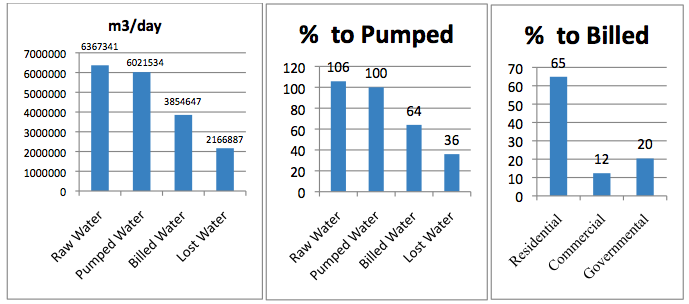
Analysis of the figures shown above reveals that non-revenue water [NRW] is about 36%. Unfortunately, this quantity is not based on real measurement to distinguish between real and apparent losses. In addition, the classification of the billed water to its three main categories; residential, commercial, and governmental is based only on old data for which almost no update has been done.
In addition, the percent of the lost water inside the WTP (raw-pumped) shows that it is a theoretical calculation rather than real figures based on measures. Therefore, this analysis will be the basis for the answer of the coming question. Bearing in mind that decreasing the percentage of water losses from 36 % to 15 % will increase water revenues by an additional 462 million m3/year, which is enough water to provide to additional 5 million inhabitants in greater Cairo
I suggest five realistic steps for a non-revenue water management program for Cairo, which include the following:
Step 1:
Raise the subject of NRW with all its dimensions to the top decision makers (TDM) to attract their attention and support, enabling implementation of a plan to reduce NRW.
Step 2:
By supporting and financing the activities of reducing NRW, we start to form a task force from all the departments that should participate. This includes the technical (operation and maintenance), technical (chemist), financial, procurement, customer support, information, etc. to initiate a plan that is composed of short term, medium term, and long term sub plans.
Step 3:
Verify the different figures shown above; i.e., be sure of the real losses inside the WTP by tracing the transmission mains. In a first stage, inspect the distribution pipelines, to uncover leaks, review the bills with the real category of the consumer, and many other necessary actions to validate the data.
Step 4:
Once the picture is made more clear, we will start with the most urgent based on how much it will cost and how much will be made in its return. As an example, in my opinion, verifying the category of consumption (residential or commercial) could be considered a factor of the utmost urgency. It is justified to intervene here, as it will cost almost nothing because it is a task to be done while meter readers are doing their work. Its return is likely to be high, as many commercial activities were initiated, while no update was done for the bills.
Step 5:
Reviewing and updating the plan according to lessons learned in a reasonable amount of time; e.g. quarterly.
It is essential that new water sources are found, and new agricultural areas and cities outside the Nile River Valley are created. The only direction is to expand to the dry lands and desert, which is described as ‘Egypt’s last frontier’. Such a solution could provide an alternative to Cairo and relieve the pressure coming from a growing population. There are already several new cities and agricultural areas in the desert.
Besides finding new sources, water conservation is another strategy in national water management. In the case of Cairo, this needs commitment of government institutions and international donors, as well as Cairo inhabitants and local NGOs. Finally, if water consumption continues to grow intensively, Egypt will have to rely on extreme measures: use the non-renewable groundwater aquifers and expensive desalinization of seawater, which are not sustainable solutions.
Ayman Ramadan Mohamed Ayad is an engineer and Water Resources Advisor at National Water Resources Plan (NWRP-CP), and has been involved in the future vision for Alexandria integrated water urban development. He also teaches applied hydraulic at Alexandria Universities, and serves as the Egyptian Coordinator for NAYD (Network of African Youth for Development).
—
في بداية كل صيف مصر- بصفة عامة- والقاهرة على وجه الخصوص، تعاني من نقص شديد في المياه ,وعلى الرغم من تأكيد وسائل الإعلام أن الحالة المصرية في مجال الموارد المائية مقبولة، فإن الحقائق تقول شيئا آخر,بالإضافة إلى تحديات ندرة المياه والتلوث,فان المؤسسات الحكومية المسؤولة عن تقديم خدمات المياه تحت ضغط زيادة الميزانية.
ردا على الدعوات الناشئة للمزيد من كفاءة استخدام المياه واستراتيجيات استرداد التكاليف، وزارة الرى و الموارد المائية بدأت تدريجيا لتعزيز النهج التشاركي واللامركزي لتشغيل وصيانه البنية التحتية, كما أيدوا التدخلات غير الفنية, مثل حملات التوعية والمبادرات التي تستهدف سلوك مستخدمي المياه ولكنها تفقد الإطار القانوني القوي والقوانين المعمول بها ورسم الخرائط المؤسسية وبالتالي تخلق هيكل غير قادر على الأداء بقوة على أرض الواقع وتطبيق مفهوم المشاركة.
السياسة المائية الحالية تعطي الأولوية لمياه الشرب وقطاعات الصناعة فان زيادة ندرة المياه سوف تؤثر بشكل رئيسي على الزراعة وإنتاج الطاقة الكهرومائية والقطاعات الملاحة,أما بالنسبه للقاهرة مياه الشرب تمثل جزئيا في شركة مياه القاهرة. متوسط حجم إنتاج المياه الصالحة للشرب سنويا(م3/سنه) ومعدل يومى (م3/يوم) هو تقريبا 6مليون م3/يوم و2.2 بليون م3/سنه
تحليل الأرقام الواردة أعلاه تبين أن المياه غير-الراجعه(المفقوده) تقدر بحوالي 36٪ وللأسف، هذه الكمية لا تقوم على قياسات حقيقية للتمييز بين الخسائر الحقيقيه الظاهره وبالإضافة إلى ذلك، فإن تصنيف المياه المستحقة على الفئات الثلاث الرئيسية السكنية والتجارية، والحكومية: يستند فقط على بيانات قديمة وغالبا لا يتم تحديثها.
وبالإضافة إلى ذلك، فإن نسبه المياه المفقودة فى (الضخ) تظهر أنه حساب نظري بدلا من الأرقام الحقيقية القائمة على القياسات ولذلك، سوف يكون هذا التحليل الأساس لالإجابة عن السؤال القادم.مع الوضع في الاعتبار أن خفض نسبة الفاقد من المياه من 36٪ إلى 15٪ سوف يزيد الإيرادات المائيه ب462 مليون م3/سنه.وهو عبارة عن ماء يكفى لتوفير 5 مليون نسمة اضافيه في القاهرة الكبرى
أقترح خمس خطوات واقعية لبرنامج إدارة المياه غير إيرادات القاهرة، والتي تشمل ما يلي:
الخطوه الاولى :
رفع موضوع المياه “المفقوده “ بكل أبعادها إلى كبار صناع القرار لجذب انتباههم والدعم، مما يتيح تنفيذ خطة للحد منها
الخطوه التانيه:
من خلال دعم وتمويل أنشطة الحد من المياه المفقوده ، نبدأ في تشكيل فريق عمل من جميع الإدارات التي ينبغي أن تشارك ويشمل هذا التشغيل والصيانة والتقنية (الكيميائي) والمالية, والمشتريات, وخدمه العملاء, والمعلومات, الخ.لبدء الخطة التي تتكون خطط فرعيه على المدى القصير، وعلى المدى المتوسط والطويل .
الخطوه الثالثه :
التحقق من الاأرقام مختلفة المبينه أعلاه, أي التأكد من الخسائر الحقيقية داخل “الضخ الخام” عن طريق تتبع خطوط المياه.في المرحلة الأولى، وفحص خطوط الأنابيب والتوزيع, للكشف عن التسريبات واستعراض مشروعات القوانين للفئة الحقيقية للمستهلك، والعديد من الإجراءات اللازمة الأخرى للتحقق من صحة البيانات
الخطوه الرابعه :
وبمجرد ان تصبح الصورة أكثر وضوحا, سوف نبدأ مع الامور العاجله على أساس كم ستكلف وكم ستبذل في عودتها.وكمثال على ذلك، في رأيي، يمكن التحقق من فئة الاستهلاك (سكنية أو تجارية) يعتبر عاملا في غاية الاهميه.التدخل هنا له ما يبرره حيث أنها لن تكلف شيئا تقريبا لأنها مهمة ينبغي ان يقوم بها المحصلين حين قراءه العداد وعائدها من الراجح ان يكون عاليا, حيث العديد من الأنشطة التجارية بدات, بينما لم يجر أي تحديث لبرنامج الفواتير.
الخطوه الخامسه :
مراجعة وتحديث الخطة وفقا للدروس المستفادة في فترة مناسبه من الزمن على سبيل المثال “ربع سنويه”
من الضروري أن يتم العثور على مصادر جديدة للمياه، ويتم إنشاء مناطق زراعية جديدة ومدن خارج وادي نهر النيل.
الاتجاه الوحيد هو للتوسع في الأراضي الجافة والصحراوية، التي توصف بأنها” الحدود المصرية الاخيره”, مثل هذا الحل يمكن أن يوفر بديلا للقاهرة وتخفيف الضغط القادم من تزايد عدد السكان وهناك بالفعل العديد من المدن الجديدة والمناطق الزراعية في الصحراء.
الحفاظ على المياه- إلى جانب إيجاد مصادر جديدة- هو استراتيجية أخرى في مجال إدارة المياه الوطنية.في حالة القاهرة، هذا يحتاج التزام المؤسسات الحكومية والجهات الدولية المتبرعه, وكذلك سكان القاهرة والمنظمات غير الحكومية المحلية.وأخيرا، إذا استهلاك المياه ازداد باستمرار وبشكل مكثف، ستضطر مصر إلى الاعتماد على اجراءات صارمة مثل : استخدام خزانات المياه الجوفية غير المتجددة وتحلية مياه البحر وهى حلول غير مستدامه.
مهندس أيمن رمضان محمد عياد مستشار الموارد المائية والمياه في خطة الموارد الوطنية ، وشارك في الرؤية المستقبلية المتكامله للمياه والتنميه الحضريه للاسكندريه.ويدرس الهيدروليكه “التطبيقيه” فى جامعه الاسكندريه و يشغل منصب المنسق المصرى لشبكه الشباب الافريقى للتنميه
Please see below for information on a series of events led by Egyptian Urban Action


 Cairo from Below القاهرة من الأساس